
National Symbols
Like many countries and territories, Bonaire has its own national symbols, including a flag, a coat of arms, and a national anthem. The Bonairean national anthem has been used for almost fifty years, while the flag and coat of arms are much more recent additions. Both were created and officially adopted during the late 1980s.
The Flag of Bonaire
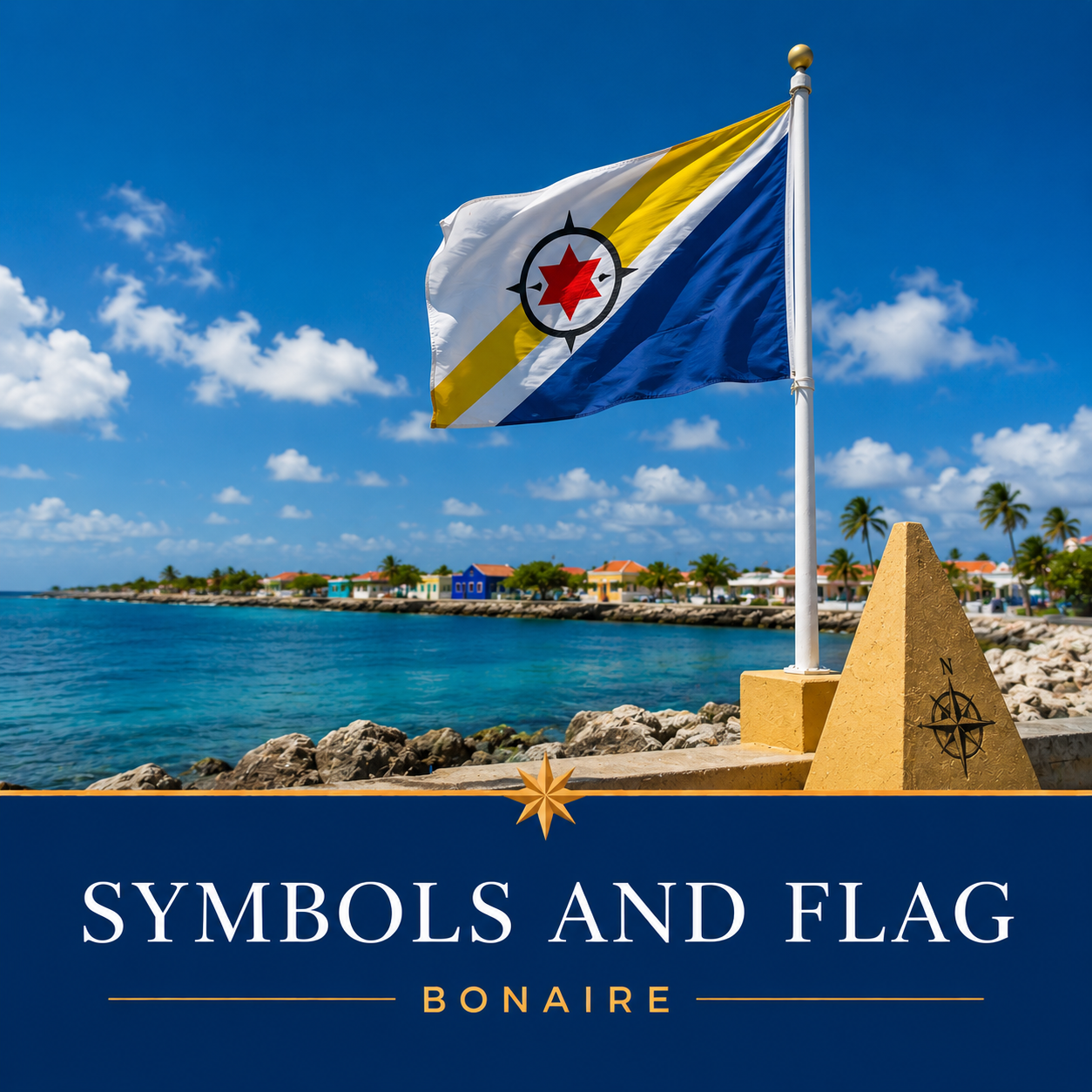
Bonaire’s flag has been officially used since 11 December 1981. Its design was developed according to the guidelines of Professor Whitney Smith. The rectangular flag has a 2:3 ratio and is divided by diagonally rising stripes.
The flag contains three colors: yellow, white, and blue. In the center of the white stripe is a black four-pointed compass rose with a red six-pointed star inside it. These same elements are also found in Bonaire’s coat of arms. Each color and symbol has a special meaning connected to the island’s history, people, and natural environment.
National Anthem
The national anthem of Bonaire is called “Tera di Solo y Suave Biento,” which means Land of Sun and Gentle Wind. It has been the island’s official anthem since 1964. The lyrics are written in Papiamento and were composed by Hubert O. Booi, celebrating Bonaire’s culture, natural beauty, and identity.
Coat of Arms of Bonaire
Bonaire officially adopted its coat of arms on 26 December 1986. The design includes an azure blue shield topped with a crown, symbolizing the island’s connection to the Kingdom of the Netherlands.
Several meaningful symbols appear on the shield:
A golden steering wheel, representing Bonaire’s maritime history and its sailors.
A black four-pointed compass rose, symbolizing navigation and the island’s seafaring traditions.
A red six-pointed star, representing the six original settlements of Bonaire: Playa, Nikiboko, Tera Kora, Antriol, Noord Saliña, and Rincon. The compass rose and red star are also featured on Bonaire’s national flag, linking the two important national symbols.
Architecture
Bonaire’s architecture reflects a blend of Dutch colonial influences and Caribbean design. Many traditional buildings are brightly painted and constructed to withstand the island’s warm climate, making use of natural ventilation and shaded outdoor spaces.