The Culture of Bonaire
Bonaire is known for its remarkable cultural diversity. More than seventy nationalities have contributed to the island’s population over the centuries, creating a unique blend of traditions, languages, and customs. This multicultural character is not only part of Bonaire’s history but continues to grow today.
Many people from nearby countries move to Bonaire for employment opportunities, adding even more variety to the island’s culture. Most immigrants come from places such as the Dominican Republic, the European Netherlands, Colombia, Venezuela, North America, Peru, United State of America and China. Their presence has helped shape the modern identity of Bonaire.
During the past five hundred years, Bonaire, Aruba, and the other former Netherlands Antilles have been influenced by several different cultures and political powers. As a result, Bonaire developed a predominantly Latino-Caribbean identity combined with strong Dutch influences. In contrast, the Upper Wind Islands have a more Anglo-Caribbean character with noticeable American influences.
Languages Spoken on Bonaire
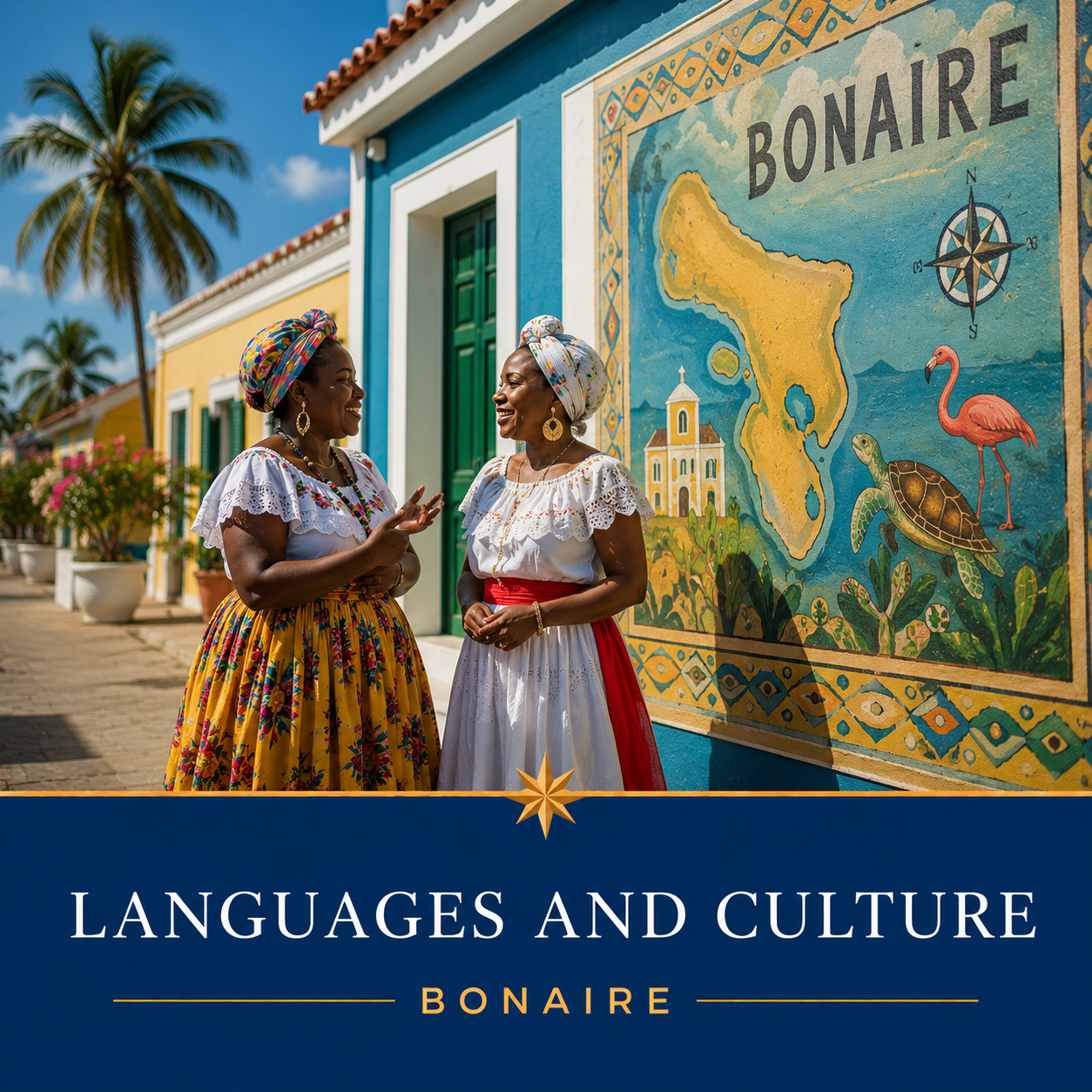
Bonaire has two official languages: Papiamento and Dutch. Papiamento is the language most commonly spoken by residents in everyday life, while Dutch is used for government, administration, and official documentation on the island.
I prefer this response Languages of Bonaire
Although Papiamento and Dutch are Bonaire’s official languages, many residents also speak English and Spanish at home. The island’s multicultural population makes it common for people to communicate in several languages.
Papiamento is a Creole language that originated from Portuguese and has been influenced by Indigenous languages, Spanish, English, French, Dutch, and several African languages. It is also spoken on the neighboring islands of Aruba and Curaçao.
The language has strong similarities to the Creole spoken in the Cape Verde Islands. Approximately 60% of Papiamento’s vocabulary comes from Spanish and Portuguese, 25% has Dutch origins, and the remaining 15% is derived from English, French, Indigenous, and African languages.
Archival Material
In 2013, the website ‘Archivo Boneiru’ was launched. This digital platform features thousands of documents, photos, films, and sound recordings regarding the history and inhabitants of Bonaire. In this way, Bonairians and European Dutch people can learn much more about the culture of the Caribbean island.
Sports and Recreation on Bonaire
Sports are an important part of everyday life on Bonaire and bring communities together. Among the many activities enjoyed by residents, baseball, football, and dominoes are especially popular.
Baseball holds a special place in Bonairian culture and is considered the island’s most important sport. Throughout the Caribbean region, baseball is widely followed and is deeply connected to local identity. On Bonaire, its popularity is comparable to the importance of football in the Netherlands.
Despite being a small island, Bonaire also has a diverse media and sports environment, allowing residents to follow local and international competitions while participating in a wide range of recreational activities.
Sports and a Healthier Lifestyle
The Bonairean government recognizes that sports play an important role in improving the health and well-being of the community. For this reason, a comprehensive sports agenda is being developed to encourage more residents to participate in physical activities and sporting events.
Increasing participation in sports is seen as an important way to promote a healthier lifestyle and reduce lifestyle-related health problems, such as obesity and high blood pressure.
The long-term goal is to raise awareness among residents that regular physical activity is essential for maintaining good health. Through improved facilities, organized activities, and community programs, the government aims to create more opportunities for everyone on Bonaire to stay active.
Dominoes
Bonairians love playing dominoes. The game with dominoes is the most important national game on Bonaire.
Baseball
Baseball is, so to speak, the most important sport on Bonaire. Kralendijk alone has three baseball fields where games are underway almost every Sunday.
Rincon is the home base of the ‘Stadium Antonio Trenidad’. This stadium has a capacity of 1,500 seats.
The baseball fields are not laid with green grass, but consist of red soil with pebbles. Furthermore, there are dozens of other baseball fields throughout the island where Bonairian youth can enjoy this game.
There are several Bonairian baseball players who have been or still play in Major League Baseball (MLB), the highest level of American professional baseball.
Football
The Bonaire League is the highest football division on Bonaire. The competition has been organized by the Bonairian Football Association (BVB) since 1961. Artvro Charles is the current national coach of Bonaire. Incidentally, the BVB is not affiliated with FIFA; as a result, the football association unfortunately misses out on a lot of financial support.
Rincon has two football teams that play in the Bonaire League: Vespo (founded on April 9, 1959) and Real Rincon.
The Bonairian national team plays in the ABCS tournament annually, among others. It is a tournament in which Aruba, Curaçao, and Suriname also participate. The cup surprisingly went to Bonaire in 2011.
Football Development on Bonaire
Football continues to grow in popularity on Bonaire, especially among young players. To support the development of local talent, well-known Dutch football players regularly visit the island to organize football clinics, training sessions, and coaching workshops. These activities provide young Bonairian footballers and local coaches with opportunities to improve their skills and learn from experienced professionals.
Artificial Turf Football Fields
The development of football facilities on Bonaire received an important boost in 2012 through a partnership between the KNVB (Royal Dutch Football Association) and Edel Grass. With financial support from a FIFA subsidy, the KNVB invested in projects designed to strengthen and promote football on the island.
As part of this initiative, two professional artificial turf football fields were constructed. The Bonairean government was responsible for preparing the foundations and supporting infrastructure, with the construction work carried out by the Bonairian Road Construction Company (BWM).
The two main artificial turf fields are located at:
Queen Beatrix College in Antriol, Kralendijk
Rincon Stadium
Both fields use Edel Future DS artificial turf, providing modern facilities for training and competitions.
In addition to these larger football fields, Bonaire also expanded its sports infrastructure with a small artificial turf field at Sentro di Bario Nort’i Salina and an artificial turf baseball and softball field at Sonrisa Ballpark.